Lehua Gray

Staff Product Designer — AI & agentic experiences

I make technical software clear and understandable.

Ten years designing software that carries real operational risk — incident response, agentic AI, healthcare and essential service access. I lead design for PagerDuty's AI and Automation pillar: I set the agentic standards for the platform and elevate the craft of my team.

SRE Agent investigating an incident on its own. Ops Console and SRE Agent are the first thing you see on PagerDuty's marketing home page.
1 of 3 SRE AGENT ADOPTION, COMPANY-WIDE TOP-LINE OKR
$500K ARR in under three months, new AIOps SKU
4M+ Patients connected to social services
#1 Engagement of every agent PagerDuty shipped

Selected work

Five projects, picked for what changed after they shipped.

01PagerDuty · AI pillar design lead · Flagship

SRE Agent

PagerDuty's flagship AI and its biggest strategic bet. Nobody knew what an SRE agent should be — half the industry still doesn't — so I went and found out. 30+ customer interviews, moderated testing, and conversational analysis of every real conversation customers had with it.

Research pushed me to fight for a web-first launch against the assumption it should be Slack-only, which turned out to be right: teams that later adopted Slack still tell us they prefer the console. It became the top-engagement agent at PagerDuty, adopted by NVIDIA, Salesforce, and New York Life, won displacements against Resolve AI, and set the company standard for what a good agent launch looks like. Checkout.com reduced the people needed to resolve a major incident by 25% within two months.

Role
Design owner; pillar design lead for AIOps, then the new AI and Automation team
Stakes
Company-wide OKR 1 of 3; four delivery teams realigned behind it
RESEARCH METHODS
Conversational analysis in Arize, 30+ customer interviews, moderated testing
Read the case study →
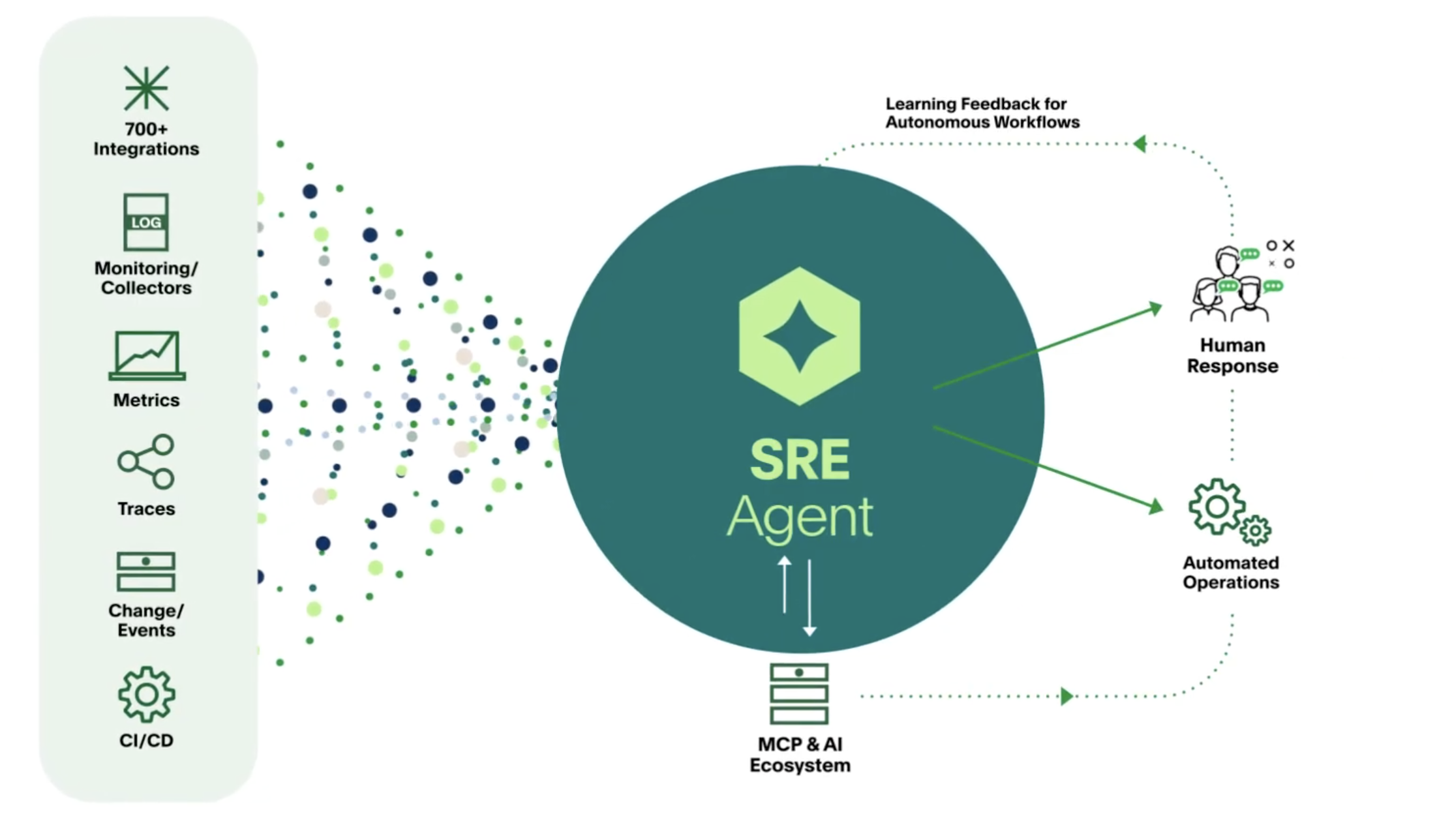
Diagram: 700+ integrations, monitoring, metrics, traces, change events and CI/CD feeding into SRE Agent, which sends outputs to human response and automated operations, with a learning feedback loop returning through the MCP and AI ecosystem.
Everything the agent reads on the left, everywhere its conclusions go on the right. The dotted return path is what makes it improve.
Live triage across every active incident. The console updates itself, which is why teams leave it open all day.
02PagerDuty · 0-to-1 · Greenfield

Operations Console

Enterprise teams had no way to see their whole incident landscape at once. I designed a live-updating console for instant triage across all of it. The greenfield product replaced PagerDuty's most-used page, and became the basis for their new home page.

I defined, designed, validated, and iterated on a tight timeline — one of three 0-to-1 products I took from a vague one-sentence concept to launch. It became PagerDuty's stickiest surface, and the incidents list everyone uses now is based on these designs.

ADOPTION
PagerDuty's stickiest feature — 4+ hour average sessions
Users
A market PagerDuty hadn't targeted: central ops. Cloudflare, Fox, Cox Automotive
Afterlife
Basis for the new home page, the incidents list, and the home for AI agents
03PagerDuty · Low-code / no-code logic engine

Event Orchestration

Customers needed to automate complex operational tasks with deeply nested conditional logic, without writing code. I designed a low-code/no-code engine that made that logic visible, editable, and understandable to technical and non-technical users alike.

I rooted the designs in customer interviews and real-time usage analysis. In early access, customers were doing in days what used to take months, and ease of use won deals outright — TD Bank chose us over IBM Watson specifically because of it. Adoption drove 24M events into automation, up from near zero. A year later I designed the second iteration: drag-and-drop rule recombination for customers drowning in rules, and one-click AI-recommended setup for customers who had none.

Speed
Customers doing in days what used to take months
Reach
919 customers, 128M events processed. Twilio, Fox, Priceline, DraftKings
CUSTOMER FEEDBACK
Adoption linked to 30% lower FTE costs and 46% fewer incidents
Read the case study →
A walkthrough of the rule builder — nested conditions, no code. Watch on YouTube →
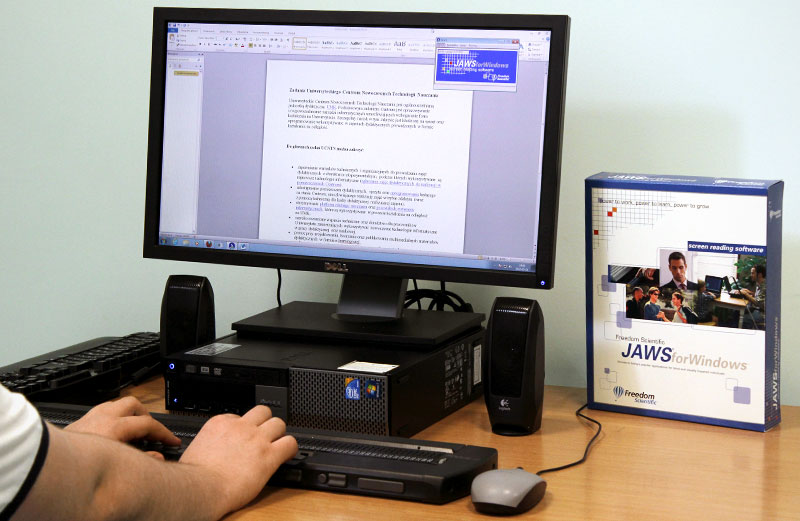
A desk running JAWS for Windows screen reading software, with the software's box beside the monitor.
JAWS, the screen reader I tested with, including user testing sessions with blind and disabled participants.
04PagerDuty, Findhelp, TK20 · Twelve years of it

Making accessibility somebody's job

I'm passionate and knowledgeable about accessibility, so I've owned it at three companies — unlocking government, education, and enterprise buyers who can't sign without 508 compliance. At PagerDuty I wrote the accessibility specs for global components, ran the audits, trained UX, product, and engineering, and earned the company its first VPAT.

I've user tested system-wide components with blind and disabled participants. At Findhelp I audited every user-facing page and documented the company's first UX pattern and color guidelines. At TK20 I audited and spec'd WCAG 2 AA for 1,000+ pages. I also built an audit guide, instruction video, and template so anyone on any team can test their own work — and pitched the hackweek project that fixed our worst issues, which won Champion the Customer. Everyone agrees accessibility matters; my contribution is building the thing that makes it an institutional habit.

COMPANY STANDARDS
WCAG 2 AA specs for global components and testing processes
FIRST VPAT
Ran the certification project for PagerDuty, Findhelp, and Tk20 
Reach
Training for UX, product, QA, engineering
05Findhelp · 2016—2021 · Earlier work I still like

Person-centered navigation tools

A CMS study came with pages of requirements written to benefit data analysts, not the case managers doing the work. Every minute they spent entering data was a minute not spent with a patient. I reframed it: build what case managers actually needed, with systems that gather study data incidentally and automatically.

I did most of the research and all of the synthesis, working alongside a social worker on staff, and co-designed with the Camden Coalition through weekly sessions. I acted as both PM and designer on this project. From a case manager migrating off a competitor's platform: “Wow! This system, it just works!”

Scale
4M+ patients connected to social services
Result
Most-used part of the platform; biggest source of sales leads
Legacy
Design and data standards adopted across SDoH by major EMRs
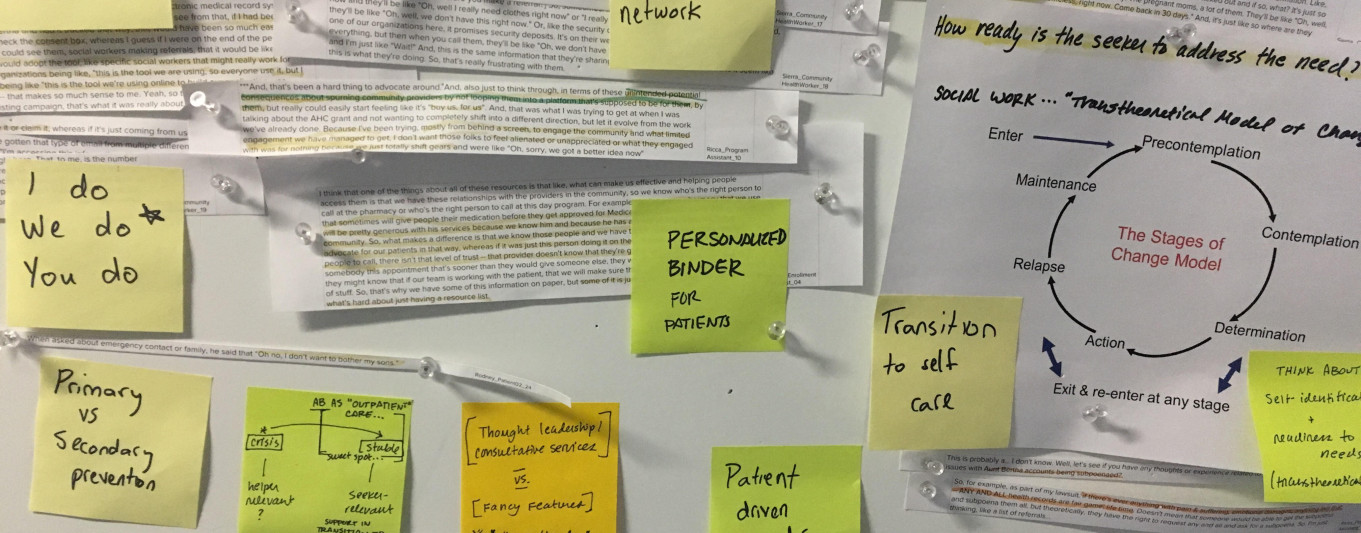
Research synthesis wall: printed interview transcripts, sticky notes reading “I do / We do / You do”, “Personalized binder for patients”, and a hand-drawn Stages of Change model.
Synthesis from contextual research with case managers and social workers. The Stages of Change model on the right became the spine of the tool.
What the wall above turned into: goals, needs, and referrals for one person in a single view, so entering the data was the same act as doing the work.

How I work

Patterns over pages

I set the agentic patterns, the review process, and the design direction the combined AIOps and AI pillar scaled on. AIOps was the first department to use the pillar-lead model, and the cadence we built became the template replicated across PagerDuty.

Evidence, then opinion

Conversational analysis and LLM evals, session recordings, SQL, moderated testing. I added conversational analysis to the org's research practice, which is how we shipped fixes before customers asked for them. Coming in with a finding rather than a preference gives everyone something solid to build on.

People, then process

I mentored two senior designers and an intern, and sponsored both seniors through promotion — the part of the job I'd keep doing anywhere. I widen my impact by elevating the craft of the people around me: critique cadence, cross-functional alignment, and standards that hold after I leave the room.

Design systems. Lead designer on PagerDuty's design systems team, serving 20+ designers and hundreds of engineers. Defined a system-wide language for complex workflow interactions.

AI in the practice. Built Claude design skills adopted company-wide: a requirements-to-documentation pipeline accurate to the design system, plus automated first-pass heuristic, accessibility, and copy review.

Alignment. I paired hundreds of hours of interviews with data nobody had pulled and turned it into a story the whole company could plan around. It became a shared goal and a new position.

Recognition. Admitted to the PagerDuty Champions Club for top 1% performers. Won multiple hackweeks on improvements I pitched — Best Product Enhancement, Champion the Customer.

Personal

A few things I made on the side.

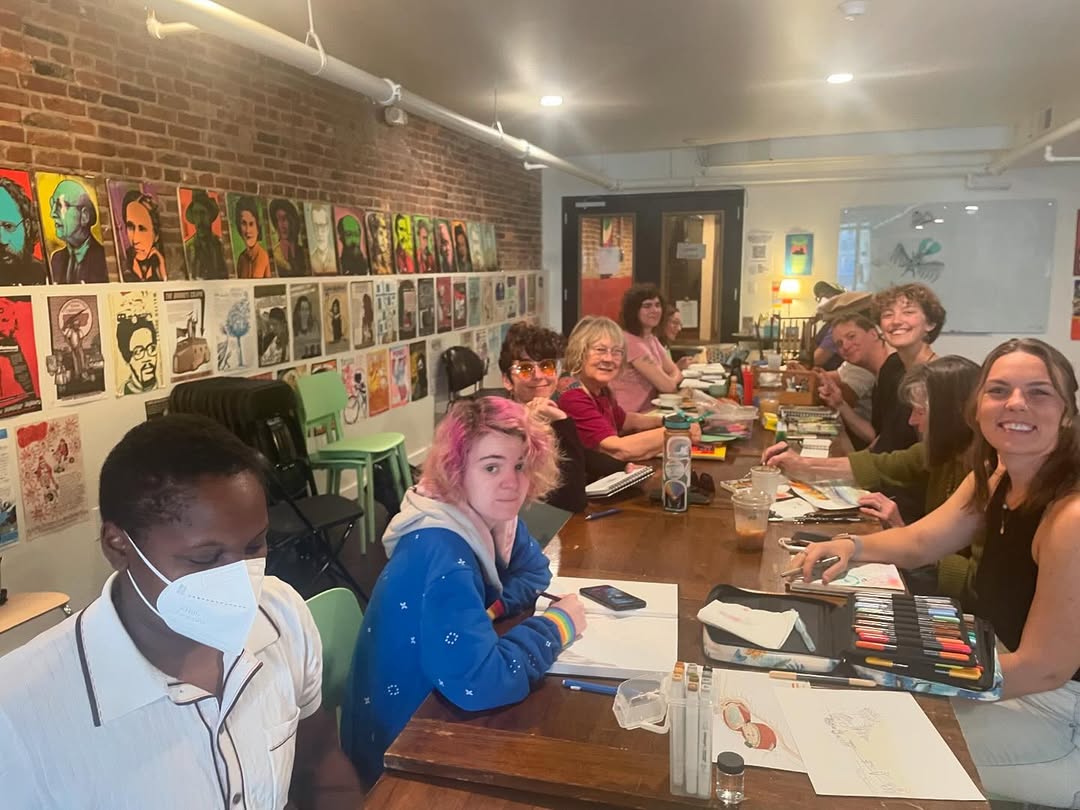
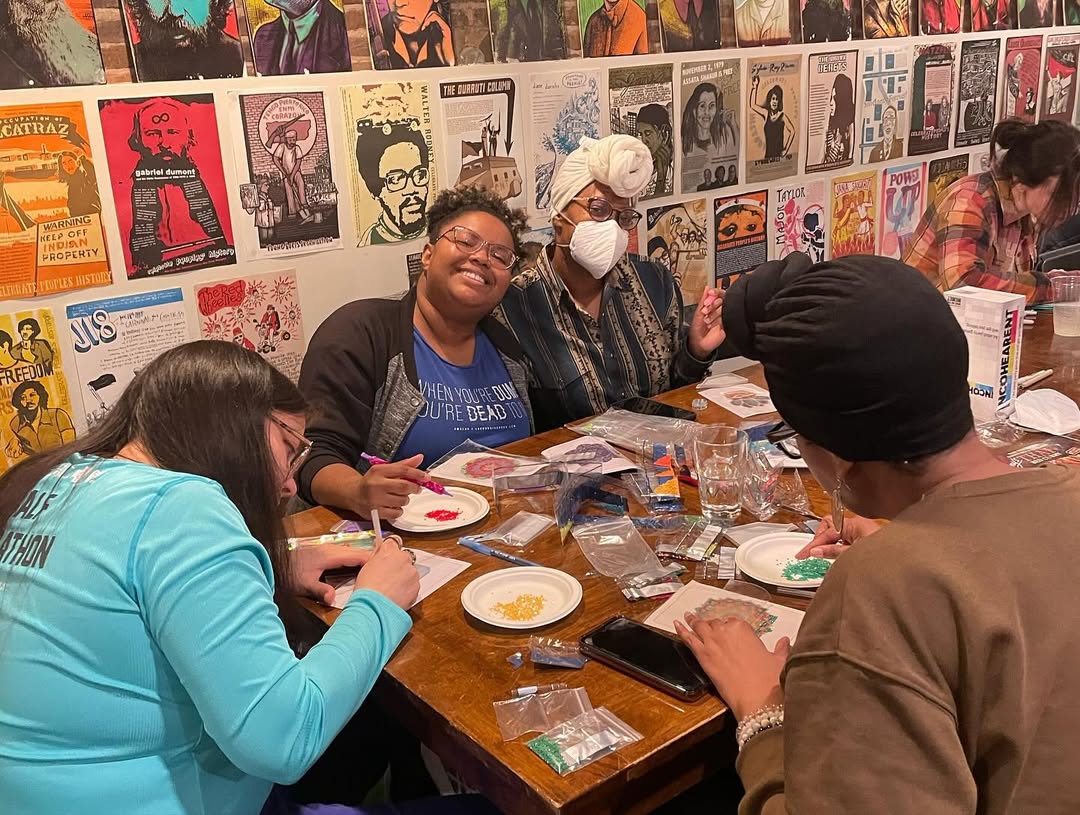
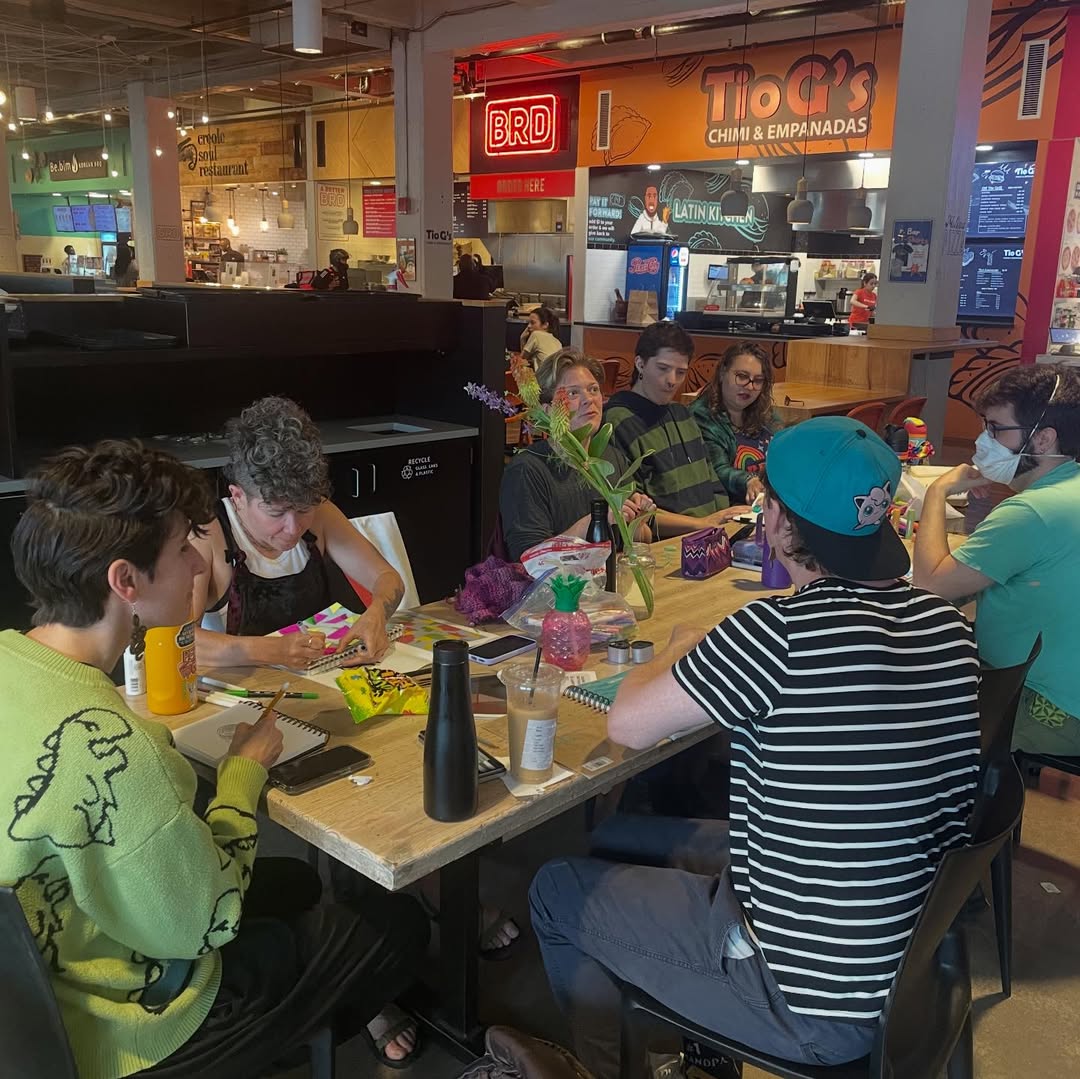
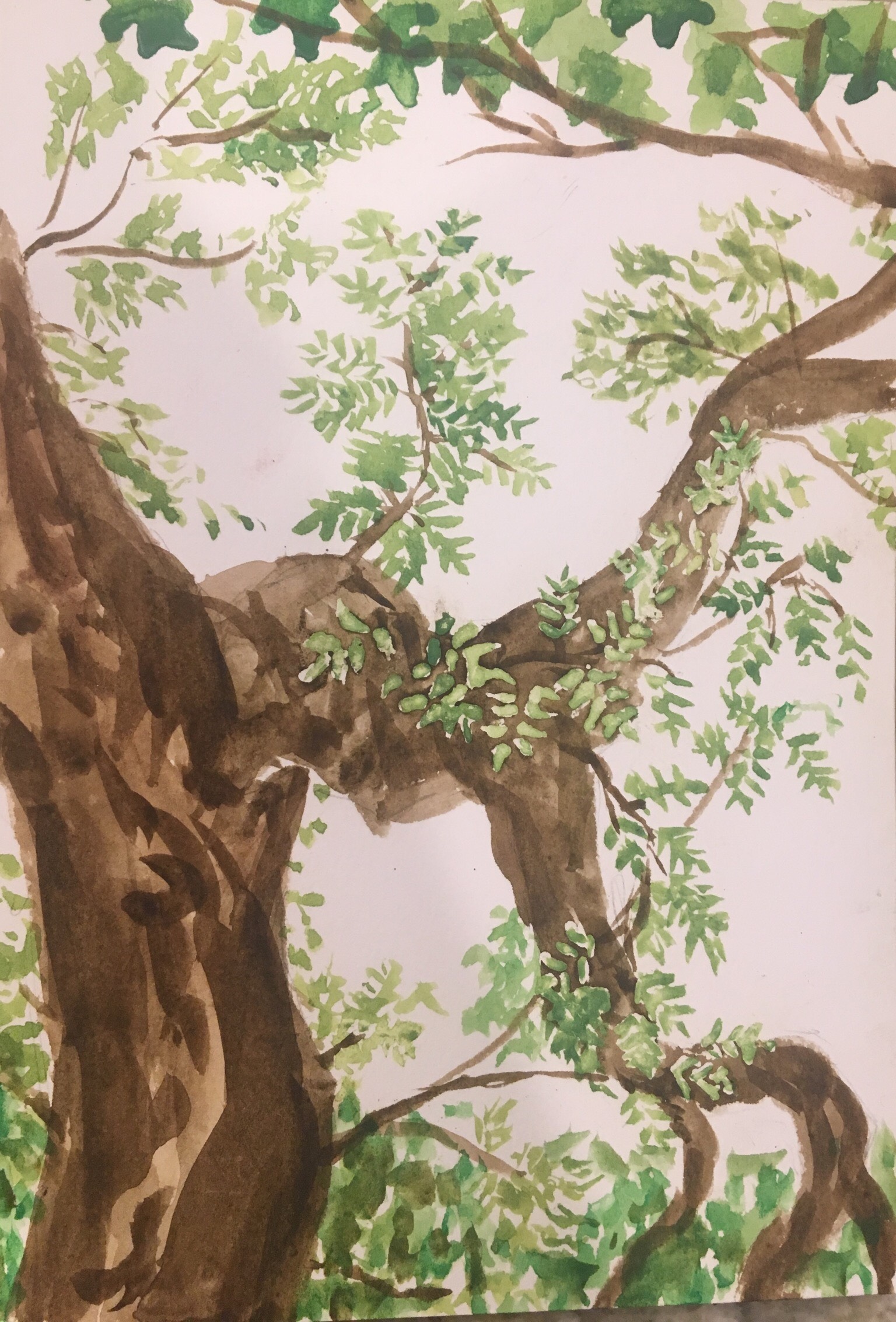
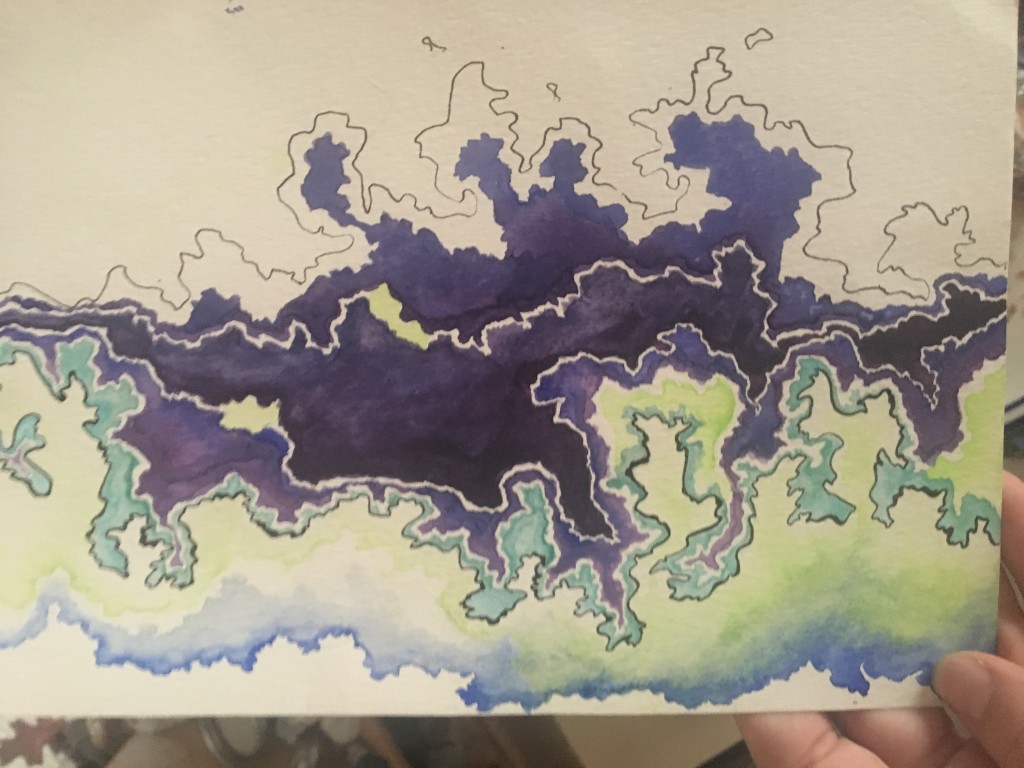
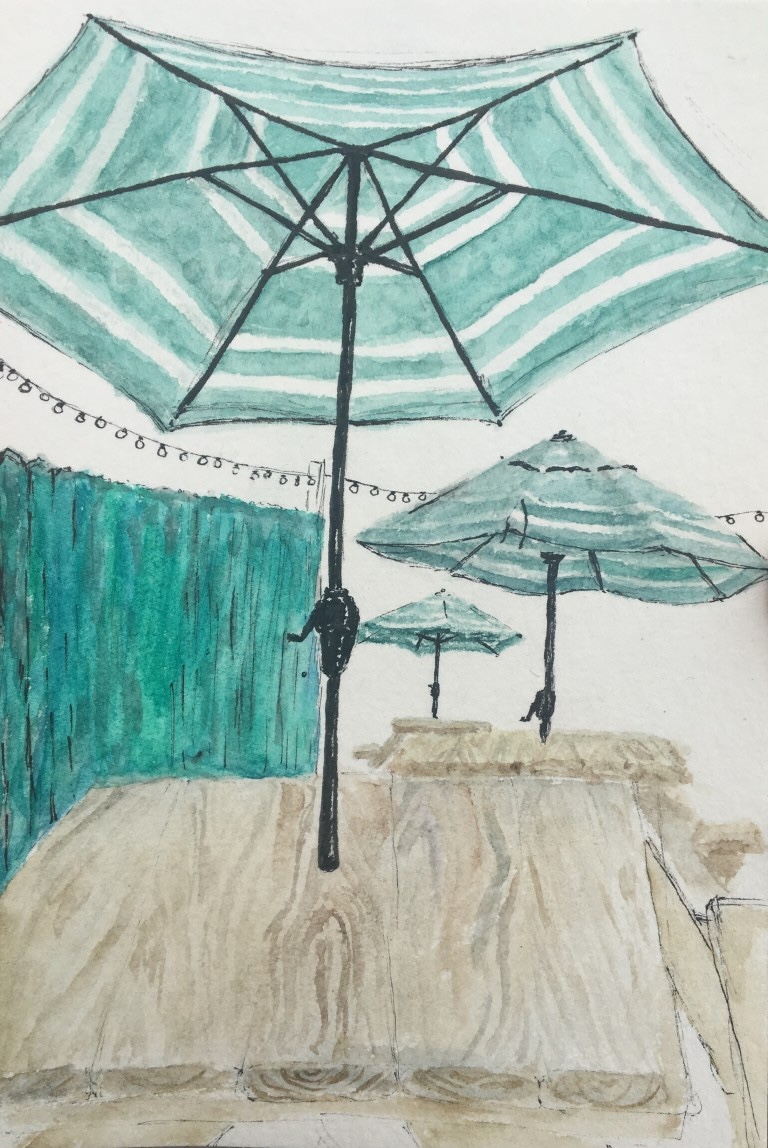
Drawing ClubEvery Sunday I host a coffee-and-drawing meet-up for artists. This has built a community of creatives and protects time for creative pursuits. My work is watercolor and ink.
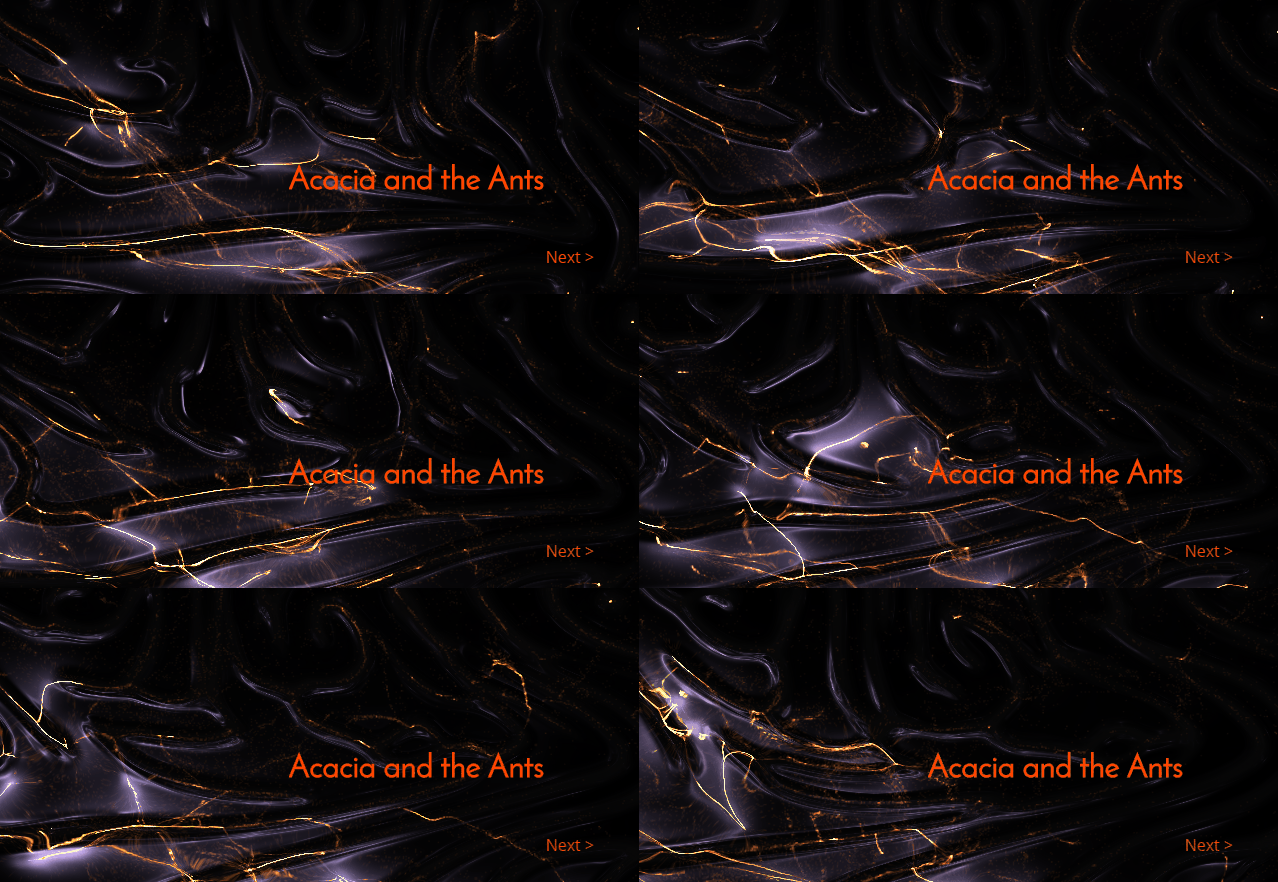
Animated canvas art: orange filaments of light drifting across a dark liquid surface, titled “Acacia and the Ants”.
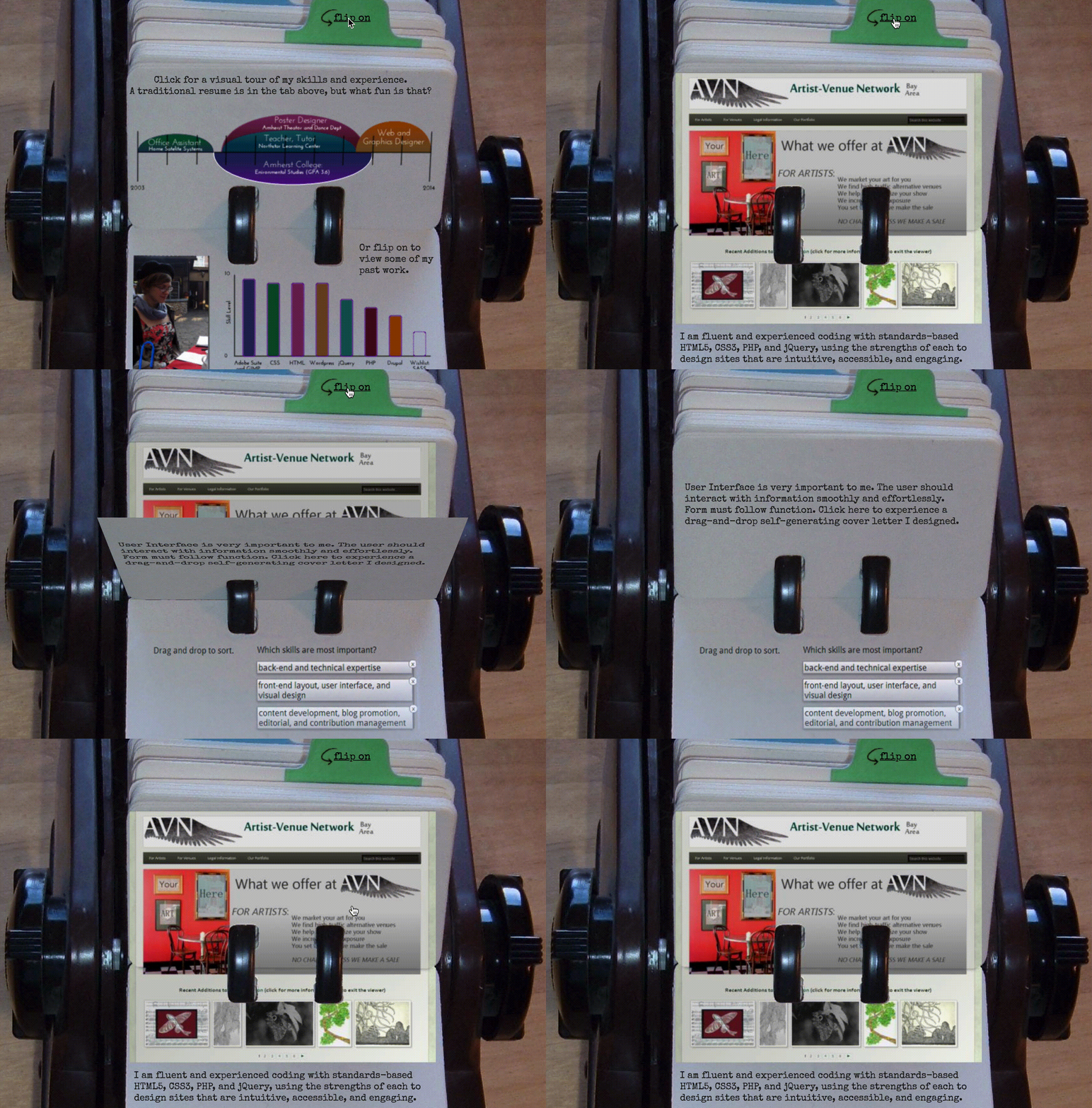
Acacia and the AntsOne of my short stories, told with in HTML canvas art. It was an experiment from long ago, but I still like it.
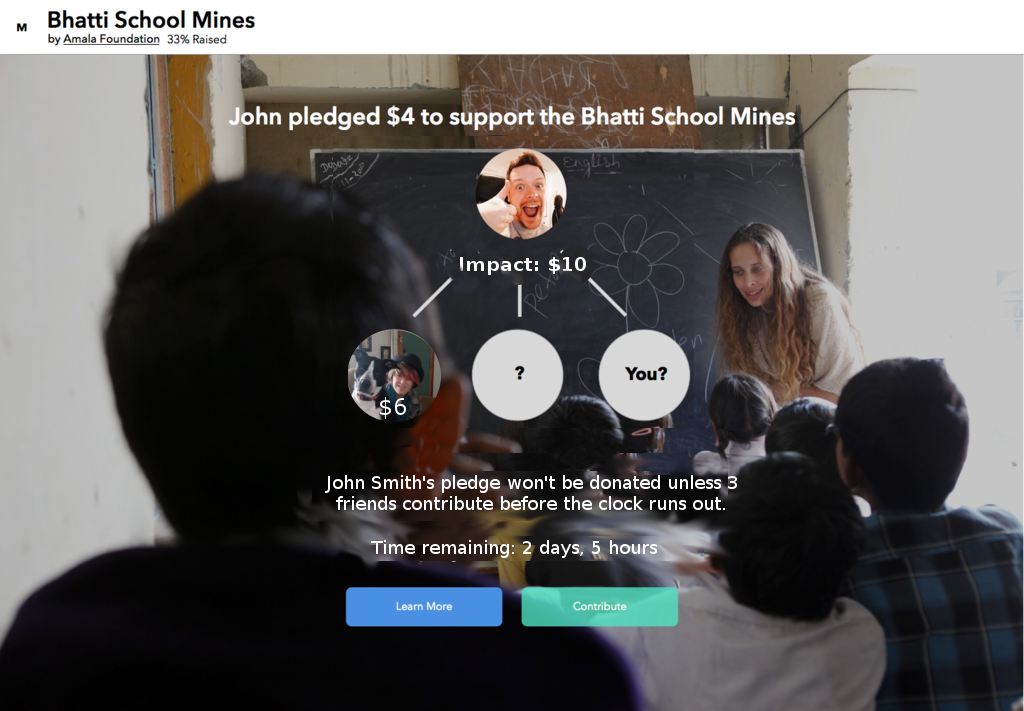
MultiplyMe fundraising page for Back on My Feet Austin, showing 70 supporters and $1,309 raised of $2,000.
MultiplyMeA white-labeled nonprofit fundraising platform I conceived of and co-founded, which raised ten times more than a traditional campaign. First place at the eBay OpportunityHack and C4TK. 
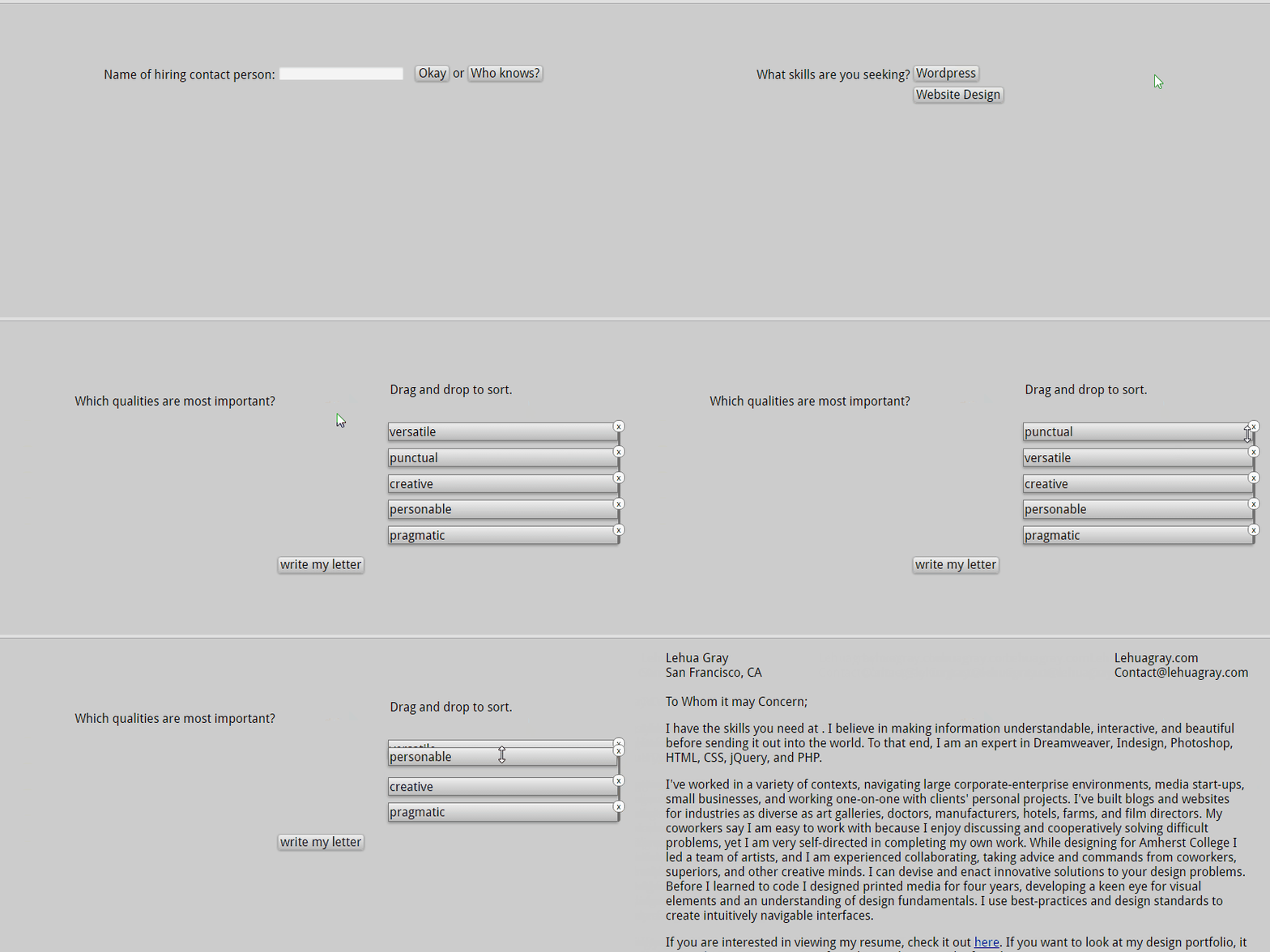
Cover Letter Builder: a form asking for the name of the hiring contact person, with “Okay” and “Who knows?” buttons.
Cover Letter BuilderSilly tool I built many years before LLM's existed, I hated writing cover letters. I built a JavaScript tool to drag-and-drop keywords and customize a coverletter instantly. 
Drawing Club Watercolor and ink
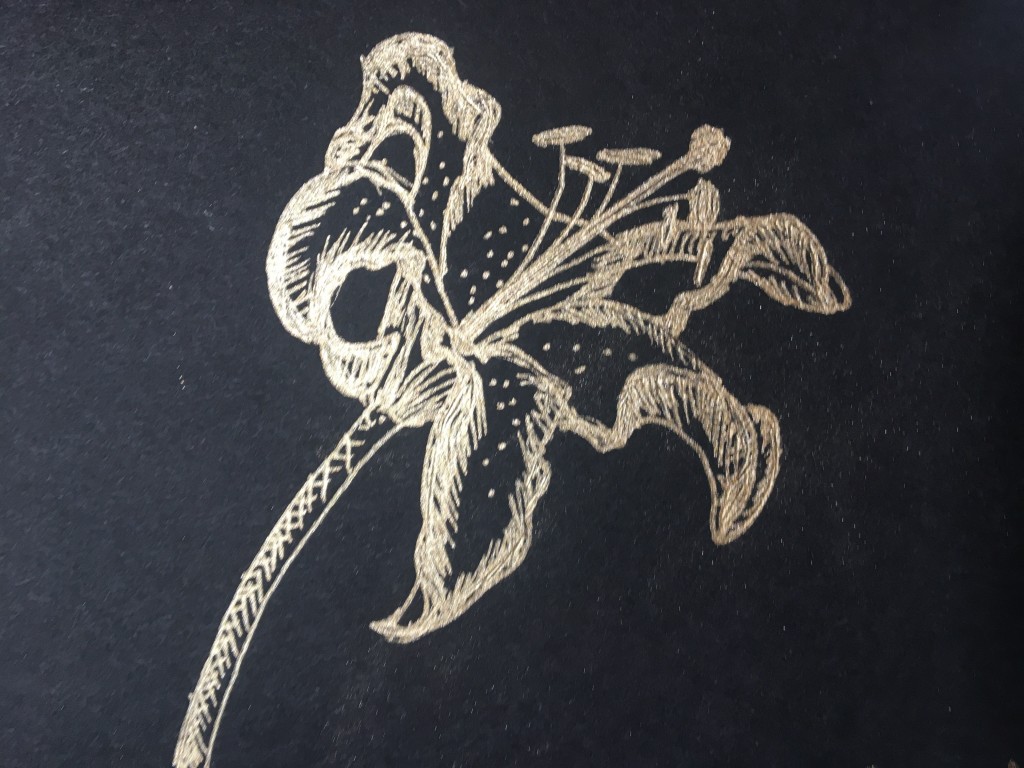
Watercolor looking up into the branches of a large tree, painted in browns and greens. Watercolor of storm clouds in deep purple and blue over yellow-green, with ink outlines tracing the cloud edges. Watercolor and ink of striped teal patio umbrellas beside a wooden building. Gold ink drawing of a lily in fine hatched lines on black paper.
Portrait of Lehua Gray in glasses and a navy polka-dot shirt against a light grey background.
Baltimore · remote

About

I feel at home working on projects that are still vague one-sentence concepts or building out processes and standards for a team that has none. I'm a self-starter happy to dig into the data, talk to the customer, and figure out the root of the customer problem. I value the amazing working relationships I build with my cross-functional teams. In my past I've held the roles of PM and developer, so I know how alignment gets made, from all sides of the triangle. The question that has been holding my attention lately is what trust should look like when software is making decisions on its own.

Now Open to new roles. Previously Staff Product Designer and AI pillar design lead at PagerDuty.
Before PagerDuty (2021—26) · Findhelp (2016—21) · TK20/Watermark (2014—16) · MultiplyMe · freelance
Depth in Agentic AI · design systems · WCAG 2 AA accessibility · discovery and data analysis (SQL, BigQuery)
Download résumé (PDF) ↓

Let's talk.

Best for: Principal and Staff roles on AI-native products, and design leadership where the org needs patterns as much as pixels, 0-to-1 projects that need to scale to an enterprise level.

lehua.gray@gmail.com LinkedIn